


Explore the deeper layers of Korea.
For many international students, Korea first appears through a screen.
K-pop. K-dramas. YouTube shorts. Campus reels. Street food clips. Seoul cafés. Fashion. Night views. Subway stations. Convenience stores. The fast, modern, stylish side of Korea is powerful — and for many students, it is the reason they first become curious about studying here.
There is nothing wrong with that. But Korea is also older, quieter and deeper than its global pop culture image.
That became very clear to me during a recent visit to Beomeosa Temple in Busan.
I had been invited to take part in a Korea Tourism Organization photo shoot at Beomeosa Temple, together with a small group of international participants. At the invitation of Chung Yi Yoon, Global Partnership Director of Beomeosa’s Temple Cuisine Culture Research Institute, we were introduced to several elements of Beomeosa’s cultural program.
It became much more than a photo shoot.It became a reminder that cultural learning does not always happen in a classroom.
Sometimes it happens while making a lotus lantern. Sometimes it happens during a silent walk through a forest. And sometimes it happens when you sit down for a meal and are asked one simple question:
“Where has this food come from?”
Beomeosa Temple: a historic place that is still alive
Beomeosa Temple is one of Busan’s most important historic temples. Located on Geumjeongsan Mountain in the northern part of the city, it was founded in 678 during the Silla period.
But Beomeosa is not only a historical site.
It is still an active place of Korean Buddhist practice, ritual, meditation, cultural learning and hospitality. That is what makes it especially interesting for international students. It is not a museum where culture is placed behind glass. It is a living place where history, architecture, nature, ritual and daily practice come together.
You can read more about Beomeosa Temple through the official Templestay page:
Beomeosa Temple – Templestay
Culture is not only something you watch
Much of Korean culture reaches international students through media. They watch Korea before they arrive.
They watch the music, the food, the language, the cities, the student life and the atmosphere. That can be exciting and inspiring. But there is a difference between watching culture and entering it.
At Beomeosa, the experience was physical, slow and direct.
We made lotus lanterns. We painted traditional lotus-patterned fans. We listened to explanations about temple rituals. We joined a silent meditative walk through the forest area of the temple.These activities were not presented as tourist entertainment. They were quiet introductions to attention, symbolism, patience and respect.
No scrolling. – No rushing. – No need to perform.
Just paying attention.
Such experience can be surprisingly powerful. Student life abroad often comes with pressure: language pressure, social pressure, academic pressure, financial pressure and the constant need to adapt. A program like this offers a different rhythm. It asks students to slow down and notice where they are.
That too is part of learning.
A temple outside — and perhaps also inside
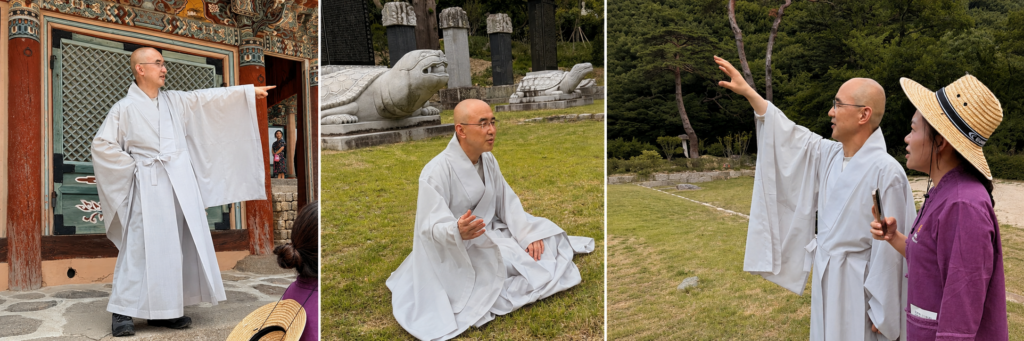
One of the most memorable parts of the visit was the explanation by Monk Suk San (석산 스님).
His way of explaining was calm, clear and cheerful. He helped us understand that temple rituals are not simply performances for visitors. They are practices of attention.
One idea especially stayed with me.
As I understood it, prayer in the temple is not only about looking outward. It is also about turning inward — toward the place within ourselves where clarity, compassion and awareness can be cultivated.
This does not need to be approached only as a religious idea. It can also be understood as a cultural and human one.
Students come to Korea to learn the language, explore universities, build a career path or experience life in Asia. But along the way, they also meet ideas that invite reflection. Korean Buddhist culture offers one of those doors.
The temple is not only a place in the mountains.It can also become a way to look inward.
The silent walk: learning without a lecture
The silent meditative walk through the forest area of Beomeosa was one of the simplest parts of the program.And perhaps exactly because of that, it was one of the strongest.
When you’re used to busy campuses, public transport, study deadlines, social media, part-time work and daily notifications, silence can feel unusual at first. Almost uncomfortable.
But after a while, the surroundings become more present.
The sound of your steps – The trees – The mountain air – The space between people – The fact that nobody needs to fill the moment with words.
This is a different kind of learning. There is no lecture, no exam and no certificate. But there is still something to understand: a place, a rhythm, a tradition, and maybe also yourself within it.
Temple cuisine: food as culture, not only taste
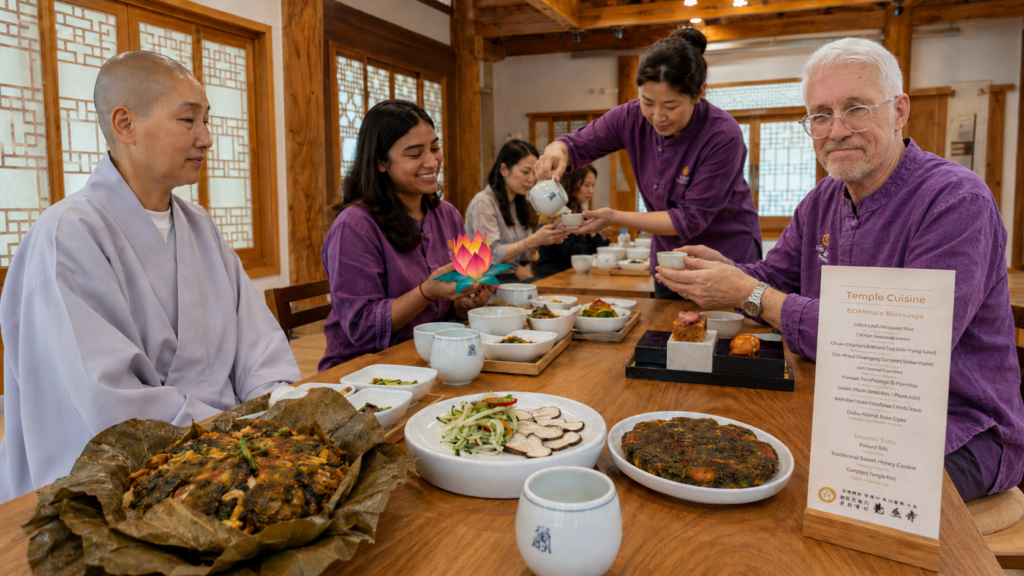
The temple cuisine lunch was another highlight of the day.
It was introduced to us as Palace Food, and that description made sense as soon as we tasted it. Every dish showed precision, restraint and balance. It was not extravagant, but refined in a quiet and deeply thoughtful way — the kind of food that clearly reflects knowledge, discipline and care.
Before eating, we reflected on the traditional pre-meal question:
“Where has this food come from?”
That question changed the meal. It was no longer only about taste. It was also about gratitude, effort, ingredients, preparation and awareness.
The menu included lotus leaf-wrapped rice, chilled cucumber soup, pine mushroom and fresh ginseng salad, stir-fried glass noodles, Korean mint pancake, soybean paste stew, crispy kelp and rice chips, flower tea, traditional Korean honey cookie and candied tangerine.
For students who are interested in Korean food, temple cuisine opens another door. It is very different from Korean barbecue, fried chicken, convenience store food or street snacks. It is plant-based, seasonal, restrained and closely connected to Korean Buddhist culture.
Korean temple food is not simply “vegetarian food”. It is a food culture shaped by ideas of mindfulness, balance, respect for ingredients and harmony with nature.
More about Korean temple food:
Korean Temple Food
What this can add to a study experience in Korea
At KoreaStudyGuide, we are currently expanding our overview of short programs in Korea, alongside university degree programs and Korean language education.
This visit confirmed why that matters.
Not every international student may come to Korea for a full bachelor’s or master’s degree. Some students come for a Korean language program. Some come for an exchange semester. Some are interested in summer schools, gap-year experiences, cultural orientation programs or short educational stays.
For all these students, programs such as Templestay, temple cuisine workshops and cultural courses can add real value.
They help students understand Korea beyond campuses, classrooms and textbooks.
Korea beyond the obvious image
K-pop, K-drama, Korean fashion, cafés and modern city life are all part of Korea’s global attraction. But they are not the whole story.
Korea is also mountain temples, silence, ritual, seasonal food, traditional crafts, Buddhist thought, respect for ingredients and carefully preserved cultural practices.
The ‘modern’ and the ‘traditional’ are not opposites in Korea. They exist side by side.
You can study Korean in a modern language classroom, drink coffee in a busy university district, take the subway across Busan, and then find yourselve walking silently through the forest of a temple founded more than a thousand years ago.
That contrast is not a contradiction.
It is one of the reasons Korea is such a fascinating study destination
Who consider a Templestay or temple culture program?
A Templestay or related temple culture program may be especially interesting for:
- Korean language students who want more cultural context
- exchange students in Busan or elsewhere in Korea
- gap-year students looking for meaningful short experiences
- university groups or study tour groups
- students interested in Asian studies, religion, philosophy or cultural heritage
- students interested in food culture, sustainability or plant-based cuisine
- parents and counselors looking for structured cultural programs
- students who want to experience Korea beyond the usual tourist route
A program like this does not replace academic study. But it can deepen it.
It can help understand that culture is not only something to consume. It is something to enter carefully, respectfully and with curiosity.
A meaningful example from Busan
My sincere thanks go to Monk Suk San (석산 스님) for his calm and joyful explanations, to Chung Yi Yoon for organizing this meaningful visit, to Beomeosa’s Temple Cuisine Culture Research Institute, and to the Korea Tourism Organization for making the experience possible.
For me, this visit was more than a personal cultural experience.
It was also a reminder of the kind of opportunities international students should know about.
Some programs teach language, some programs explain history and some experiences help students feel, taste and understand the deeper layers of Korea. . Beomeosa offered a strong example of that.

At KoreaStudyGuide, we will continue to list and explain study routes, Korean language education and short cultural programs in Busan and beyond.
Because studying in Korea is not only about where and what you study.
It is also about what you learn to notice.
More information:
KoreaStudyGuide
