


“The quality of a school is not measured by the absence of problems, but by the way adults deal with them.”
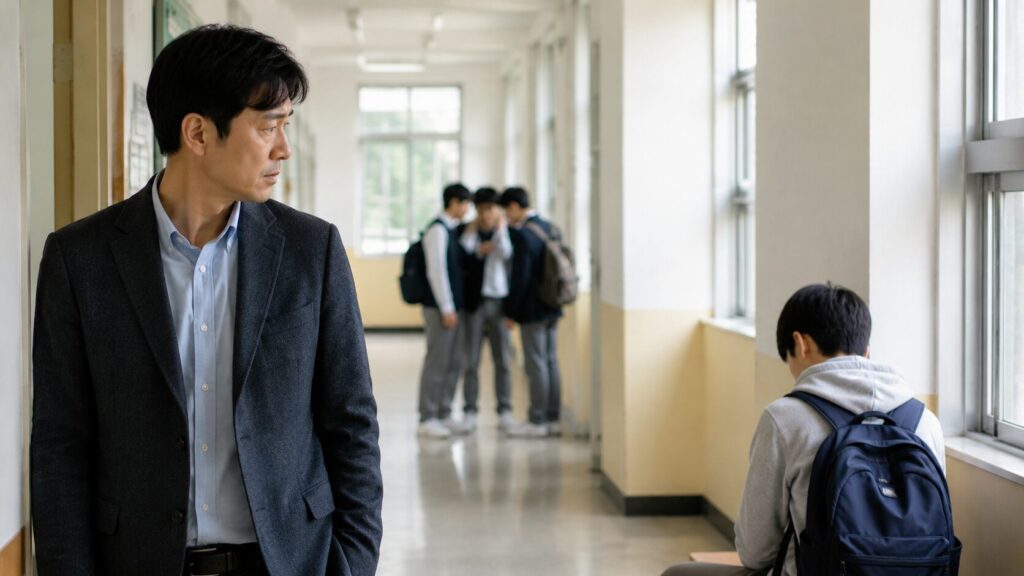
Like many foreigners living in Korea, I occasionally enjoy watching Korean dramas. Some are romantic, some historical, and others simply provide entertaining relief after a long day. Then I began to notice something: schools kept returning as a setting. Again and again there was a lonely student, a group of classmates making life increasingly unbearable, teachers who clearly saw that something was wrong yet somehow seemed unable to stop it, and parents desperately trying to protect their child. Other parents arrived with influence, confidence and, quite often, considerable wealth. Somewhere in the middle stood a school leader trying to preserve the school’s reputation and maintain peace in a situation that had already gone much too far.
The discovery began on the sofa
At first, I assumed it was simply good television. Drama needs conflict, and Dutch television exaggerates too. But the pattern kept returning in different stories, written by different people and broadcast by different networks. The details changed; the underlying questions did not. As someone who has spent more than four decades working in and around schools, I became curious – not because I wanted to judge Korean education, but because I wanted to understand it.
The Korea I thought I knew
Before moving to South Korea, my image of Korean education was shaped largely by international comparisons: outstanding academic performance, hard-working students, dedicated parents, strong universities and a society that genuinely values learning. That image was not invented. In the OECD’s 2022 PISA assessment, Korean 15-year-olds performed substantially above the OECD average in mathematics, reading and science. Korea remains one of the strongest-performing education systems in the developed world.
Perhaps above all, I associated Korea with respect for teachers. For generations, teaching occupied a special position in Korean society. The teacher was not simply an employee delivering lessons, but a figure connected with learning, discipline and moral development. That made those television classrooms all the more puzzling. How could a country with such educational success also produce so many stories in which teachers appeared powerless? I began to realise that the answer is more complicated than either international rankings or television dramas suggest.
Looking into a different mirror
It would be easy for a European educator to watch these stories and quietly conclude that this must be a Korean problem. I cannot. During my career in the Netherlands, I regularly worked as an interim school principal. Schools rarely appointed an interim principal because everything was going wonderfully. Usually the opposite was true: In addition to help teams turn insufficient learning results into better ones, I dealt with bullying, conflicts between parents and teachers, divided teams, children who no longer felt safe and teachers who had gradually lost confidence. Sometimes entire schools seemed to be waiting for somebody else to solve the problem.
The culture was Dutch, but the mechanisms often felt surprisingly familiar. That realisation changed the way I watched Korean dramas. Perhaps they were not showing me something uniquely Korean. Perhaps they were holding up a mirror that many education systems would rather not look into.
What do the numbers actually tell us?
The statistics deserve careful treatment because they tell more than one story. In the Korean Ministry of Education’s nationwide 2025 school-violence survey, 2.5 percent of participating students reported experiencing school violence. The figure was highest in elementary schools, at 5 percent, compared with 2.1 percent in middle schools and 0.7 percent in high schools. The ministry also reported that group exclusion and cyberviolence had increased, even as reported verbal and physical violence declined.
Those figures are serious, particularly because bullying that begins in elementary school can shape a child’s confidence and social development for years. International evidence, however, presents a more nuanced picture. In PISA 2022, 8 percent of Korean girls and 10 percent of Korean boys aged 15 said they experienced bullying at least several times a month. The corresponding OECD averages were 20 and 21 percent. Korean students also generally reported feeling comparatively safe on their way to school and in their classrooms.
These findings are not necessarily contradictory. The Korean national survey and PISA cover different age groups, use different definitions and ask questions in different ways. Together they show that Korea should not casually be labelled an exceptionally violent school system, but that rising domestic reports should not be dismissed simply because Korea compares favourably internationally. A low international ranking does not comfort the child who is frightened to enter a classroom.
Bullying rarely begins with violence
Good drama exaggerates. Great drama exaggerates just enough to make us uncomfortable. The most recognisable bullying scenes are often not the most violent ones. They begin with exclusion: a joke repeated too often, a nickname that is not really a nickname, a seat deliberately left empty, a group chat from which one student has disappeared, a photograph shared without permission or a table in the cafeteria where somebody is suddenly no longer welcome.
Those moments are universal. They occur in Seoul, Busan, Amsterdam and Rotterdam. Technology has made them more difficult for adults to observe. The school bell no longer marks the end of the school environment; social hierarchies, humiliation and exclusion can continue throughout the evening and enter the child’s bedroom through a telephone. This may partly explain why Korean authorities are giving digital safety and cyberviolence a more prominent place in prevention policies. Korea’s 2026 school-violence plan includes digital safety, improved professional handling of cases, early identification of vulnerable students and more integrated support for both victims and perpetrators.
When achievement quietly becomes status
Competition itself is not the problem. Healthy competition can motivate children to practise, persevere and discover what they are capable of achieving. But every highly competitive system also creates something less visible: status. Children notice remarkably early who belongs, who succeeds, whose parents possess influence, who can afford the right private education, who is admired and who is considered less important.
In Korean dramas, this hierarchy is often made extremely visible. The bully is the child of a wealthy business owner, politician or senior professional, while the victim’s parents have neither the money nor the confidence to fight the system. Reality is rarely so neatly written. Wealth does not automatically produce bullies, and children from ordinary backgrounds are not automatically victims. Nevertheless, economic and social inequalities can enter the school gate. They influence confidence, expectations and the willingness of parents to challenge professional decisions.
This is not exclusively Korean. In the Netherlands, status may be displayed less dramatically. Pressure may arrive through legal language, lengthy emails, formal complaints or parents who have become convinced that professional judgement should always give way to their individual expectations. The cultures and behaviour differ, but the effect on teachers can be remarkably similar.
Did Korean teachers lose their authority?
The answer is both yes and no. The traditional position of the Korean teacher has undoubtedly changed. Korean society has become more democratic, more individualised and more protective of children’s rights. That development was necessary. Unlimited authority is not healthy authority. Children deserve protection, parents deserve a voice and schools must be accountable. Practices once accepted as normal, including harsh physical discipline, should not be romanticised simply because classrooms may once have appeared quieter.
Whenever a system corrects one imbalance, however, it risks creating another. The latest OECD teacher survey captures this complexity. In 2024, 81 percent of Korean lower-secondary teachers said teachers were valued by students, while 71 percent felt valued by parents. An extraordinary 98 percent said teachers and students generally got along well. These figures do not support a simple story in which Korean children and parents have turned against teachers.
At the same time, only 35 percent believed teachers were valued by society as a whole. That was still above the OECD average of 22 percent, but it represented a fall of 32 percentage points since 2018. Respect may still exist inside many individual schools while confidence in the profession weakens more broadly. The same OECD study found that dealing with parent or guardian concerns was a major source of stress for 57 percent of Korean teachers. Administrative work followed at 50 percent, and maintaining classroom discipline at 49 percent. Korean teachers also reported spending six hours per week on administrative work – twice the OECD average. The problem, therefore, may not be that Korean teachers possess no authority. It may be that exercising authority has become professionally and emotionally risky.
A tragedy that changed the national conversation
In July 2023, a young elementary school teacher was found dead at her school in Seoul. Her death became the focus of a much larger national discussion about teachers’ working conditions, parental complaints and the fear that ordinary classroom interventions could lead to accusations of child abuse. In September that year, approximately 50,000 teachers gathered in Seoul to demand stronger protection, while tens of thousands more reportedly joined demonstrations elsewhere.
Their message was not a request to return to the authoritarian classrooms of the past. It was a demand for professional protection, reasonable boundaries and the ability to guide students without constantly fearing personal complaints. The government’s subsequent teacher-protection programme aimed to distinguish legitimate student guidance from child abuse, allow the immediate separation of students who seriously disrupt educational activities, transfer teacher-protection committees to district education offices and make institutions – rather than individual teachers – more responsible for handling complaints. Four legislative revisions, commonly described as the teacher-rights restoration bills, were subsequently approved to strengthen protection against malicious complaints and clarify the treatment of child-abuse allegations involving teachers.
Laws, procedures and protection matter, but none of them automatically creates a healthy school culture.
What troubled schools taught me
People sometimes ask what the secret is to reducing bullying. I wish there were one. During my years as an interim principal, I entered schools with excellent anti-bullying policies, beautiful protocols, detailed reporting procedures and perfectly constructed flowcharts. Sometimes almost nobody followed them. What made the greatest difference was usually something much less impressive on paper: consistency.
Children are extraordinarily good observers. They quickly discover whether adults truly work together. They notice when one teacher intervenes but another looks away, when a school leader speaks firmly during a meeting but avoids the difficult parent afterwards, when the victim is expected to adjust while the aggressor receives another warning, or when an incident is called ‘a misunderstanding’ because dealing with it properly would be uncomfortable.
One lesson has remained with me throughout my career: bullies are rarely afraid of punishment; they are afraid of certainty. The certainty that an adult will notice, that adults will communicate, that the story will be investigated, that behaviour will have consequences and that the victim will not be left alone after the meeting has ended. A school in which every adult responds consistently becomes a very difficult environment in which to bully. That proved true in the Netherlands, and I see no reason why it would be different in Korea.
The teacher cannot do it alone
It is tempting to turn every school problem into a question about the individual teacher. Why did the teacher not intervene, see it or contact the parents sooner? Sometimes those questions are justified, but teachers operate inside systems. A teacher who knows that the principal will offer support is more likely to intervene early. A principal who knows that the education authority will defend a reasonable professional decision is more likely to act decisively. Parents who trust that the school will investigate fairly are less likely to begin by threatening the teacher. Students who see adults acting calmly and collectively learn that boundaries are real.
Teacher authority is therefore not something an individual possesses like a badge. It is produced collectively by colleagues, school leaders, parents, legislation and society.
Perhaps authority is the wrong word
Public discussion often asks whether teachers have enough authority. Perhaps that is not quite the right question. What schools need is not stronger authority in the old sense, but stronger legitimacy: authority that is transparent, fair, professional, supported by evidence, open to questions, protected against intimidation, firm enough to establish boundaries and wise enough to listen.
That is not authoritarian education. It is modern professional authority. Children need it, teachers need it and parents need it too, particularly when emotions are high and their own child is involved.
Slowing down
Only recently, I wrote another article about something I had noticed in Korea: everybody seems to walk incredibly fast, and sometimes they almost run. Perhaps education has been running too – towards higher rankings, better universities, economic success, the next test, the next certificate and the next opportunity.
Those ambitions helped Korea achieve something extraordinary. In only a few generations, education became one of the foundations of the country’s transformation. But even successful systems must occasionally slow down long enough to ask why schools exist. Schools do not exist merely to produce examination results, win places at prestigious universities or prepare productive employees. They also exist to help children become decent human beings: to disagree without humiliating, compete without destroying, notice the person who has been excluded, use strength responsibly and discover that achievement without empathy is not really success.
A final reflection
Living in another country has taught me something unexpected: the longer you stay, the less certain you become of simple answers. As foreigners, we often arrive expecting to discover what makes another society different. Instead, we gradually discover how much we have in common.
Korean dramas first made me wonder whether Korean schools suffered from a particular problem of bullying, hierarchy and weakened teacher authority. The evidence suggests a more complicated conclusion. Korean schools are not uniquely unsafe. Most Korean teachers still report positive relationships with students and parents. Korea continues to perform exceptionally well academically, and the government has recognised the need to improve both student safety and teacher protection. But the concerns raised by teachers and the increase recorded in domestic school-violence surveys should not be dismissed.
Nor should Europeans watch from a comfortable distance. We face our own versions of the same questions. What happens when parents no longer trust professional judgement, when teachers hesitate because every intervention may become a complaint, when procedures replace relationships, or when everybody has rights but nobody feels responsible for the whole?
In the end, those Korean dramas were never really only about Korea. They were about something every teacher, parent and school leader eventually learns: children carefully watch the adults around them long before they listen to what those adults say. Perhaps that is where every meaningful educational reform must begin.
Sources and reference material
OECD, PISA 2022 Results: Korea country note and education profile.
Korean Ministry of Education, 2025 School Violence Survey and 2026 School Violence Prevention and Response Plan.
OECD, TALIS 2024 Results: Korea country note.
Korean Ministry of Education, Comprehensive Plan for Restoring and Strengthening the Protection of Educational Activities (2023).
Reuters, reporting on the September 2023 teacher demonstrations in Seoul.
Yonhap News Agency, reporting on the 2023 teacher-rights restoration legislation.
